Before we could even begin planning a self-direction program, we had to begin the transition planning process. In this post, we will start at the very beginning….starting with the fundamental question of “What is transition and transition planning? -Cheryl
When L entered middle school, I started hearing the word “transition planning” being talked about by my friends with kids older than Liam. Until then, our only thoughts about transition were assisting Liam with transitioning from building to building every 3 years to a new team. So, while the concept of transition was happening (and let’s face it, many periods could be identified as “transition periods” that were more detailed than just changing buildings and teams), this particular discussion about “transition planning” was making me nervous. Why? Because it was preparing us for the ultimate transition out of the public school system and into the “adult services world.”
So, how is transition related to special education services? In Massachusetts, transition services are available to all students on an IEP beginning at age 14. However, IDEA states that transition services begin at 16, so if you are reading this outside of Massachusetts, please check with your state law to see if transition services begin before 16.
Below are resources that will give you specific information on the transition process:
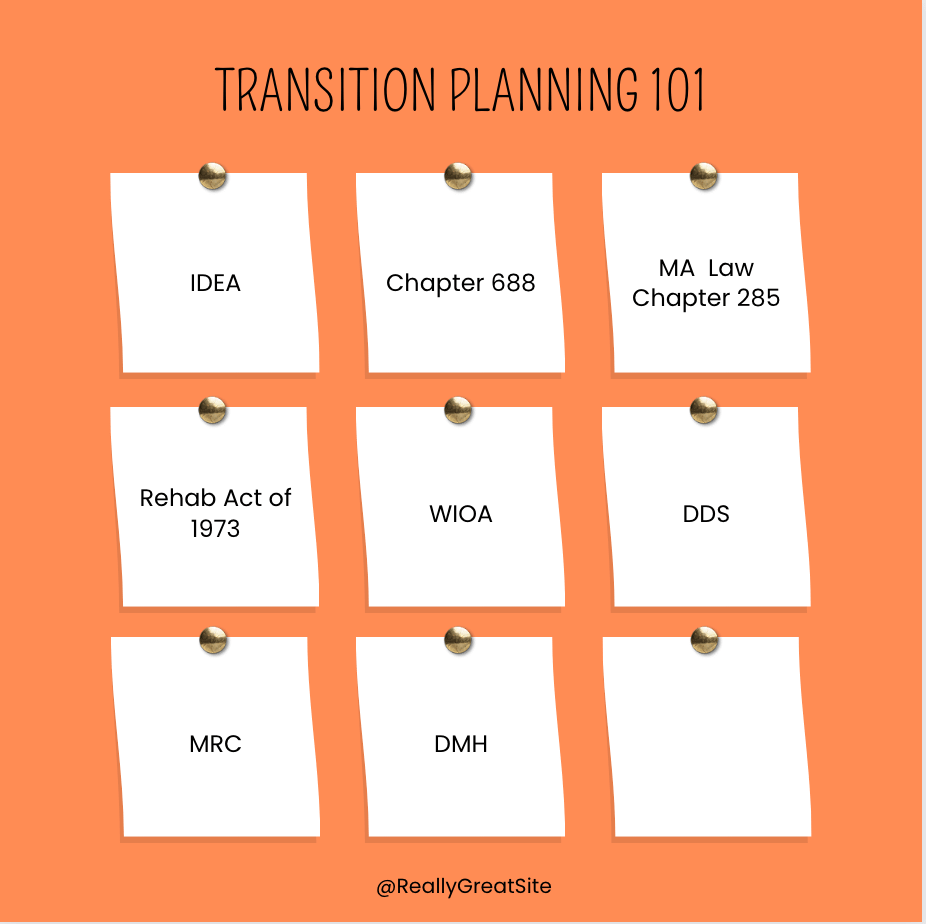
- At the federal level, IDEA 2004 Sec. 300.43 talks about transition services, including at what age they begin (16 years old at the federal level) and how they relate to the IEP. In IDEA 2004, the guiding principles specifically mention transition, stating that the education and related services that students receive should prepare them for further education, employment, and independent living. Here is the link to the IDEA 2004 website that talks explicitly about transition services: https://sites.ed.gov/idea/regs/b/a/300.43
2. In Massachusetts, we have the “Massachusetts Law Chapter 285 of the Acts of 2008 (section 2 of c.71B), which specifies that transition services begin at age 14 or sooner. This link to the DESE (Massachusetts Department of Elementary and Secondary Education) “Transition from School to Adult Life” website goes into detail about the process in Massachusetts: https://www.doe.mass.edu/sped/links/transition.html They also have a main page titled “Secondary Transition” which contains an overview of the transition process in Massachusetts with links to additional topics related to transition: https://www.doe.mass.edu/sped/secondary-transition/default.html
3. In Massachusetts, we also have the “Chapter 688 Law”, also known as the “Turning 22 Law”, which requires schools to refer eligible students to an adult service agency. In Massachusetts, those State agencies are MRC (Massachusetts Rehabilitation Commission), DDS (Department of Developmental Services), and DMH (Department of Mental Health). The DESE (Massachusetts Department of Elementary and Secondary Education) “Transition from School to Adult Life” website has a page dedicated to the 688 referral process, including brochures and referral forms: https://www.doe.mass.edu/sped/iep/688/
4. The Rehabilitation Act of 1973 is a nationwide service system to support the transition from school to employment. Here is a link to the U.S. Department of Labor’s website specifically talking about this act: https://www.dol.gov/agencies/oasam/centers-offices/civil-rights-center/statutes/section-504-rehabilitation-act-of-1973. There is also a Fact Sheet published by the Department of Health and Humans Services that discusses your rights under this act: https://www.hhs.gov/sites/default/files/ocr/civilrights/resources/factsheets/504.pdf
5. There is also the “Workforce Innovation Opportunity Act- WIOA,” which is administered by the Massachusetts Rehabilitation Commission to assist students with career exploration and post-secondary education. See the Mass.gov link for more information about this program: https://www.mass.gov/workforce-innovation-opportunity-act-wioa
The good news is that transition planning is not a “one-and-done” process. You will have many years to learn about it, and your child will have many years to adjust their vision, and thus goals, related to them. In future blog posts, we will discuss additional resources and break down the process into more detailed “chunks.”
As I have stated previously, since I am not a lawyer, this is not to be construed as legal advice. Any questions specific to your child should be addressed with the team and /or your advocate/lawyer. If you have any questions about the generalities of the transition process, please leave a comment.-Cheryl
Image created on Canva using the @ReallyGreatSite template, March 2024
 #Life Without a Filter
2 thoughts on “Transition 101 #1: It’s never too early to start planning: What is transition?”