In January 2024, Massachusetts DESE (Department of Elementary and Secondary Education) launched an updated IEP form for school districts to begin implementing. For more information specific to the rollout of these forms, please visit the “IEP Improvement Project “website at this link.
Just in time for back-to-school, today I am going to take a look at the new IEP format and where transition “lives” within it. This post will focus on the IEP form used in Massachusetts; each state utilizes its own form, so while what I am referencing will be the MA format, the transition information under IDEA should appear in your individual state’s IEP form also.
Starting no later than 14 years old, during your annual IEP meetings, the team will discuss and fill out the Transition Planning Form. This is driven by the student’s vision statement, which appears in the IEP. Transition planning strongly focuses on “person-centered planning,” where students indicate their wants and needs, likes and dislikes, and vision for the future. (See last week’s blog post (click here) for the overview of Person-Centered Planning).
In this new form, they have made some updates as to where the information is within the IEP. The most significant change is that the transition form is now embedded in the middle of the IEP form instead of at the end. Pages related to transition planning will have a green outline around them. Let’s take a look at some of the parts of the new form.
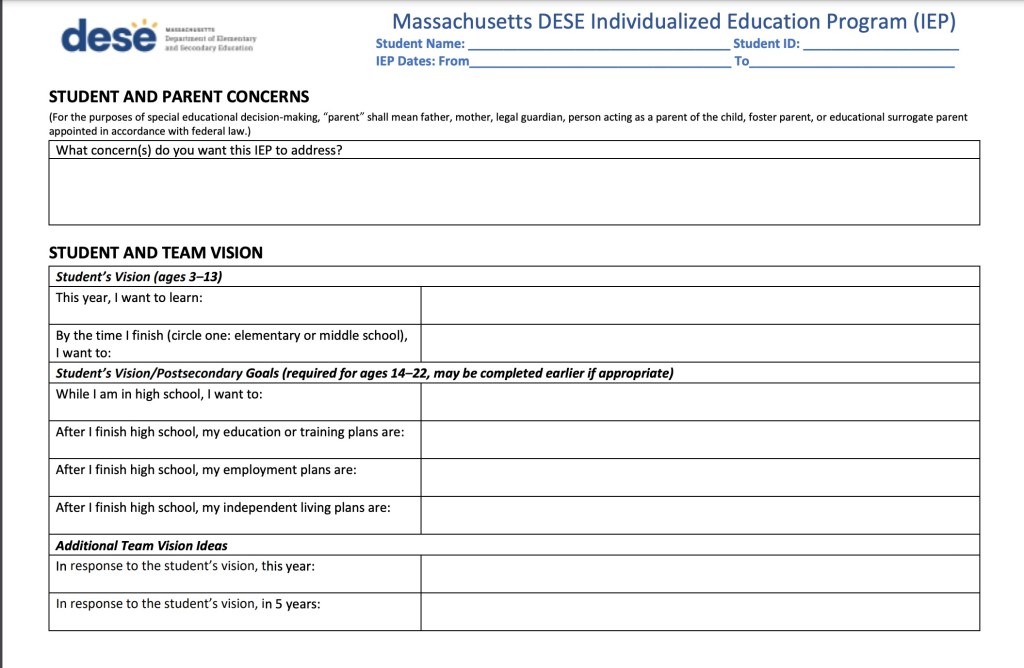
- Vision Statements: The updated IEP’s Student and Team Vision Statements look a little different. In the past, you had a box to write in; the updated format lists specific questions to be answered. They have also included the vision for ages 3-13 and 14-22 in the same section.
2. Transition Planning Form Page 1: the first page of the Transition Planning Form will ask questions related to the three pillars of transition: Further Education, Employment, and Independent Living. While similar to what was found in the previous form, what is more apparent in the new form, is that it is asking the team to identify where these areas will be addressed in the IEP. Remember, while included as part of the IEP, the transition planning form is not legally binding. Only information from the transition planning form that is included in the IEP becomes legally binding.
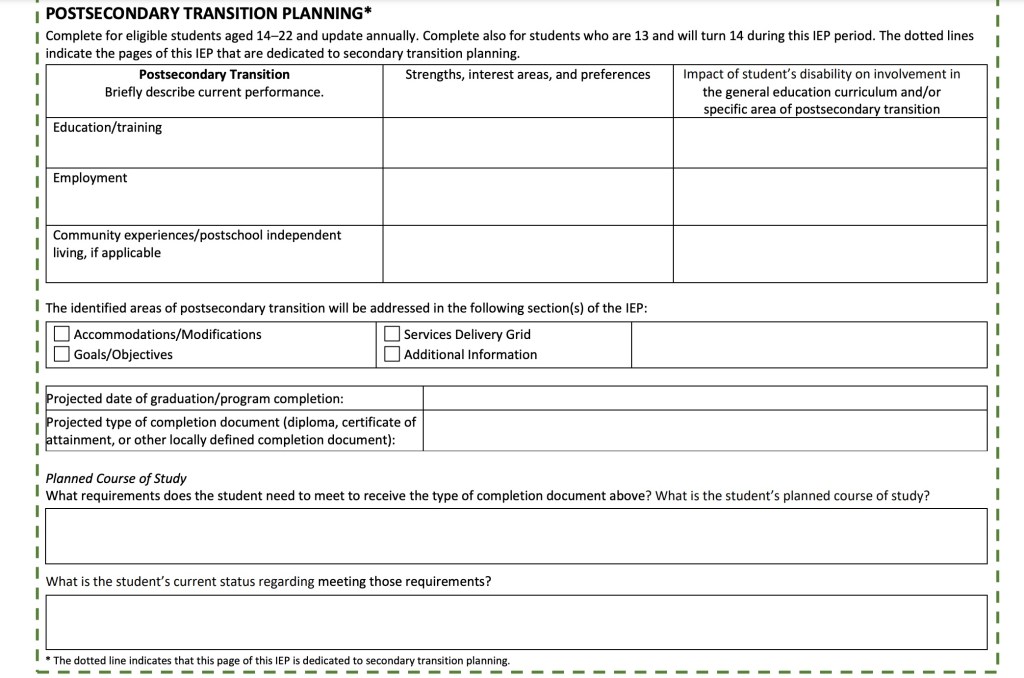
The next section, with additional information, is related to the projected graduation/program completion date. Once your student graduates, special education services end. That is why the team must discuss this information well before senior year. It should not be assumed that just because your child is on an IEP, they will automatically remain until the age of 22. We went through many, many, many conversations with our school district on L’s anticipated graduation date. In the end, we successfully advocated that while he may have met his academic requirements for a diploma (Education), he still required additional instruction under the pillars of employment and independent living skills, thus allowing him to remain within the public school setting until age 22.
3. Transition Planning Form Page 2: For this section, the team will include any outside agencies that the student may be working with during their time in the public school setting. If the student is eligible under DDS (under 18), are there any programs that they provide that the student could utilize to support transition planning? In addition to DDS, L also worked with MRC’s Pre-ETS program on self-advocacy and job skills.
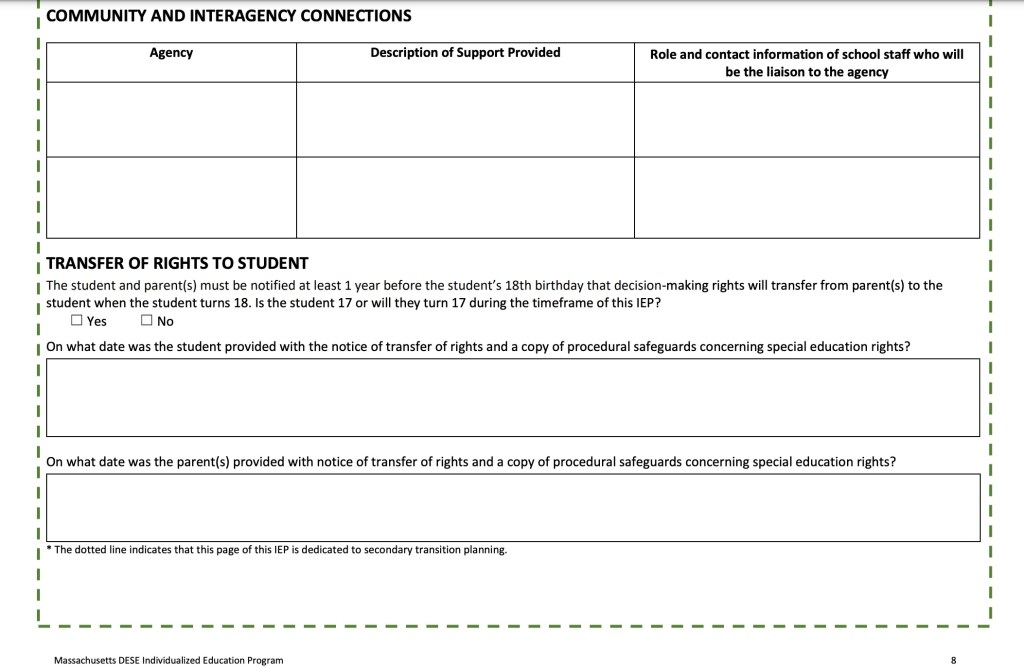
The “Transfer of Rights to Student” section: When your child turns 18, they are automatically considered a legal adult, regardless of their disability status. This means that they can also legally take over all decision-making rights. The transfer form (also called the Age of Majority form) is a safeguard for students and families: the student can decide that they want to take over all decision-making rights; that they want to have a partnership with their parents, but the student retains the final say, or the student can check off that they want their parents to continue to make all decisions for them. It should also be noted that if you obtain guardianship over your child (and if the guardianship covers these decision-making rights), the guardianship decree overrides what was initially listed in the Age of Majority form. See this website for information.
4. Transition Planning Form Page 3: This page continues collecting information on the decision-making options and choices the student makes. This section is also where guardianship will be noted. When we were going through this process, we knew that we were going to be exploring partial guardianship for L for significant decision-making. However, because of all of the forms and timeline processes, we were not able to get our court date until six months after he turned 18. Because he filled out the Age of Majority, giving us shared decision-making rights, that paperwork was in place until the court hearing. Once we received the guardianship decree, which outlines what rights he retained and those that required guardian oversight, we gave the school a copy, and that information was added to his IEP. Having this section clarifies that these items were discussed and what the outcomes were.
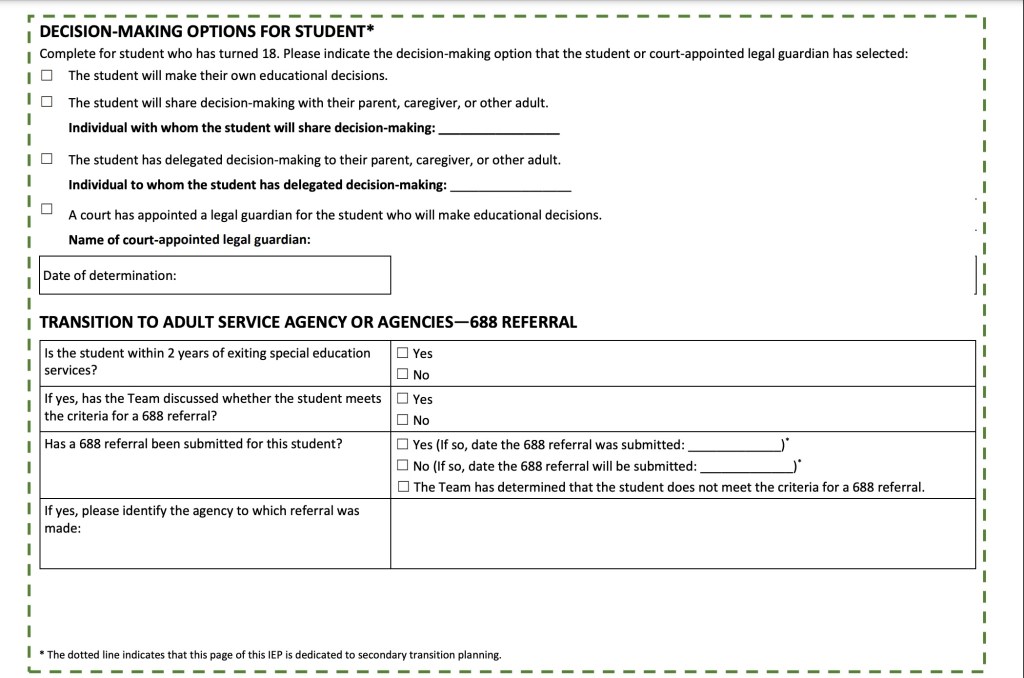
The other updated section is the “Transition to Adult Service Agency or Agencies–688 Referral”. In the various transition checklists that I reviewed in a previous blog post (click here to see it again), the 688 Referral is the form that the school generates at least two years before the student leaves school (whether via graduation or aging out) to apply to an adult service agency. Remember that adult service programs are eligibility programs, not entitlement programs. And just because your child may have received DDS eligibility as a child, it does not automatically mean that they will receive eligibility as an adult. This section clearly states what needs to be done and asks the team to check off the box to see if they have done it, and if yes, when and to what agency.
Final thoughts:
It is important to note that while the transition planning form is discussed and filled out during a team meeting, and the transition form is attached to the end of the IEP, it is NOT a legally binding document. Therefore, you want to ensure that the team takes the information gathered and recorded in the transition planning form and transfers it into the IEP as the vision statements, accommodations and modifications, and goals related to what the student would like to achieve. So think of the transition planning form as just that….a form that will then help guide the team in developing the goals and objectives within the IEP.
The good news is that once you have started using the Transition Planning Form, it will be reviewed and updated annually at the student’s IEP meeting (because the information gathered here is going to drive what the goals will be in the IEP). As with every student, what they may list as their vision at 14 years old could be vastly different than what they list at 18 years old. Our job as parents is to discuss with our kids what they see in their lives and provide opportunities for exploration and growth.
What do you think of the new layout of the IEP? What do you like about it? What do you wish could be improved? Leave a comment below!
-Cheryl
 #Life Without a Filter
One thought on “Transition 101 #6: The New Massachusetts IEP Form: Transition Planning Changes and Vision Statement Updates”