Back in episode “SD#7: Understanding the Role of your DDS Transition Coordinator and navigating the ITP process”, I talked about how the next step in the adult service journey (while your child is still receiving special education services) was to meet your transition coordinator and prepare the Individual Transition Plan, that outlined what program model the child/client is leaning towards. If you had indicated that using the self-direction model was the initial plan, you will find out from DDS if your child/client has been approved for this model. This post will go over what happens next after you have been approved to administer Self-Directed services.
Congratulations! You have completed and submitted the vision plan, have met with your DDS Transition Coordinator and prepared the Individual Transition Plan requesting Self-Directed services. Now that you have received confirmation that you can move forward with the Self-Directed planning model, the next step is to participate in an orientation to finalize that this is the correct program for your child, and that they have the family and staff support to sustain the program. In this post, I am going to review the orientation that I went through for the Participant Directed program model. If you are doing “Agency with Choice” your orientation may be a little different (and I will do a separate post on that if requested).
For a copy of the Participant Directed Program Orientation: https://www.mass.gov/info-details/tools-for-pdp-awc
Who attends the orientation?
We did L’s orientation as a Zoom meeting. Depending on the time allotted, this could be either 1 or 2 sessions, and for our orientation, we did it in 1 session, but it was about 2 1/2 hours long! The meeting consisted of L (for a brief period due to the length of the meeting), myself, our DDS Transition Coordinator, and a member of DDS who works within the Self-Directed service program.
What do you go over?
There are a total of 16 items on the orientation checklist:
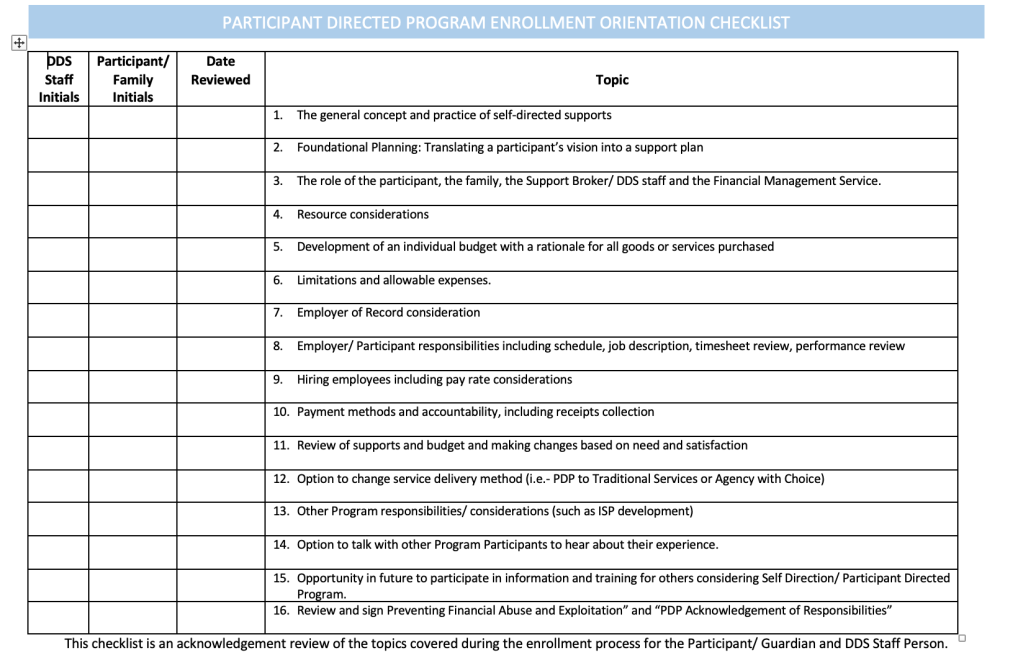
While all of the items are important, the ones that I found imperative to understand were:
–Foundational Planning: Translating a participants vision into a support plan: this is where you are going to take the person centered plan and vision plan that were completed while applying for Participant Directed services and use that information to create the Individual Support Plan for the individual. While we did not create the actual Individual Support Plan at the orientation, we did review what the ISP would entail so that we could prepare for that meeting ahead of time.
-Those items related to the budget: The “big ones” to focus on are: 1. what is the budget amount? 2. What are considered allowable expenses, what budget line item does it come out of, and what are the caps (if any) to those line items? 3. Who will be the Employer of Record, and what are the responsibilities that go along with that?
-Those items related to staffing the program: you want to get a template of a job description ( DDS requires that you have one on file for each staff member), what the pay rate is going to be (making sure that you take into consideration that the amount coming out of your budget is the pay rate plus the taxes and workman’s comp that needs to be paid into), and what you need to do to onboard your staff.
Next steps
At the end of our session, I received the verbal “approval” that we could move forward with the Participant Directed service model. I believe that having a thorough person-centered plan and vision plan previously submitted to DDS assisted us in attaining that approval and budget.
The following steps after the orientation were diving into setting up the business side of the program. In upcoming posts, I will review those processes in more detail.
-Cheryl
 #Life Without a Filter